
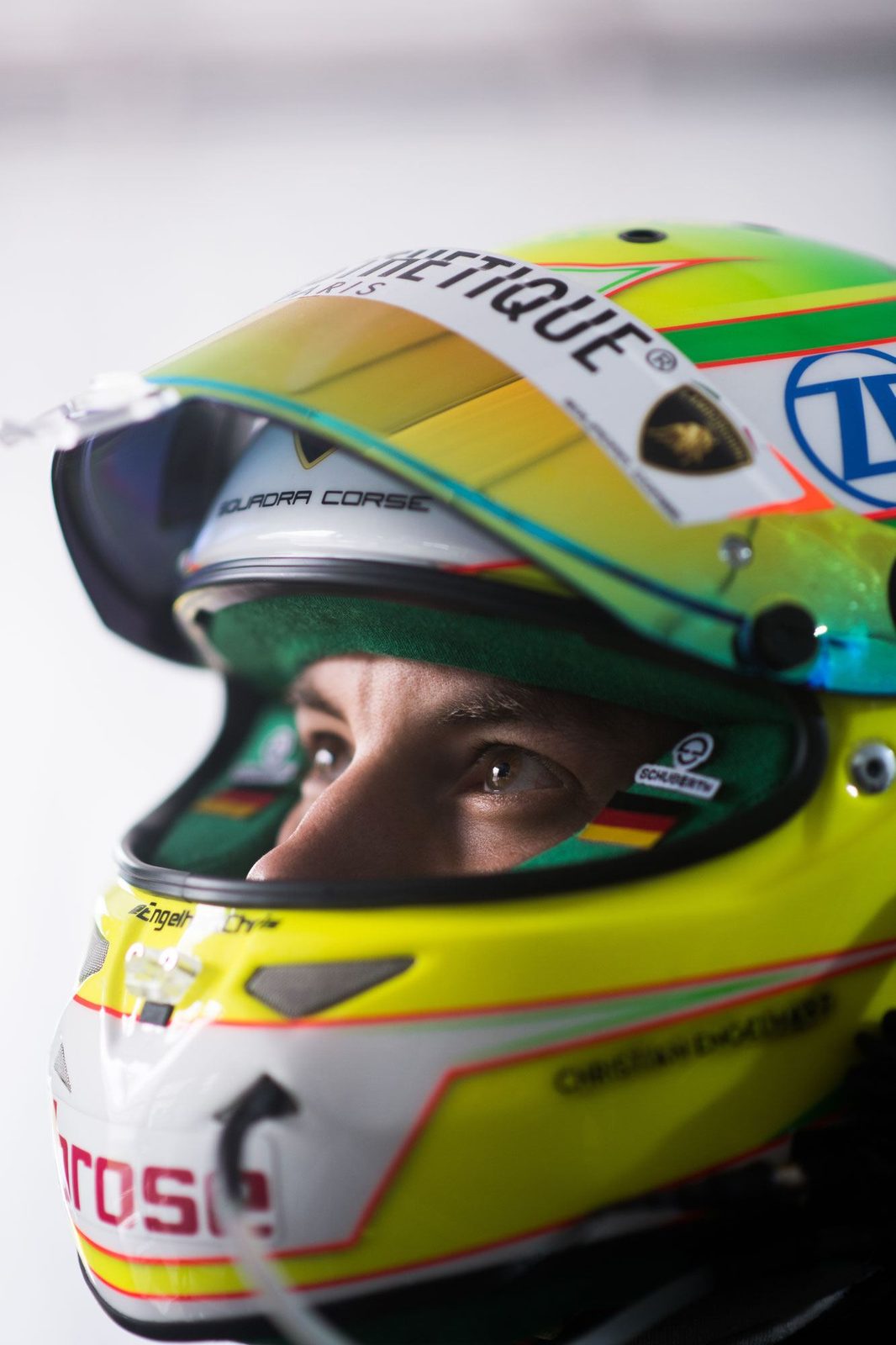
The ideaIn one sentence
You can only drive as fast as you can see ahead. Your eyes lead, your hands and feet follow.
Why it worksWhat happens in the car
The further ahead you look, the more time your brain has to plan. If you look just in front of the car, you react. If you look ahead, you anticipate.
That's why fast drivers work with reference points: a brake point, a turn-in point, the apex, the exit kerb. Fixed visual markers make every lap repeatable. And repeatable laps are the base for fast laps.
In a GT3 carAt the wheel
At 250 km/h you cover almost 70 metres every second. By the time you reach a reference point, your eyes should already be on the next one.
Endurance racing makes vision even more demanding:
- At night you only see what your headlights show. Reference points change to kerbs, marker boards and lights.
- In the rain the line moves, and so do some reference points.
- In traffic, with slower classes on track, you constantly scan ahead and in the mirrors.
On the Nordschleife, many corners are blind over a crest, like the Schwedenkreuz. You can't see the apex, so you need reference points you have learned by heart.
Common mistakesWhat I see in coaching
- Looking too short, right in front of the car.
- Fixing on the apex too long, instead of moving the eyes on to the exit.
- Looking at what you want to avoid, the wall or the gravel. You go where you look.
- No clear reference points, so every lap is different.
How I coach itMade visible with data
Together we define clear reference points for every corner. In the data I check whether your brake and turn-in points are consistent from lap to lap. Big variation often isn't a driving problem, it's a vision problem. Once the references sit, consistency follows, and then speed.
Want to work on this with me?